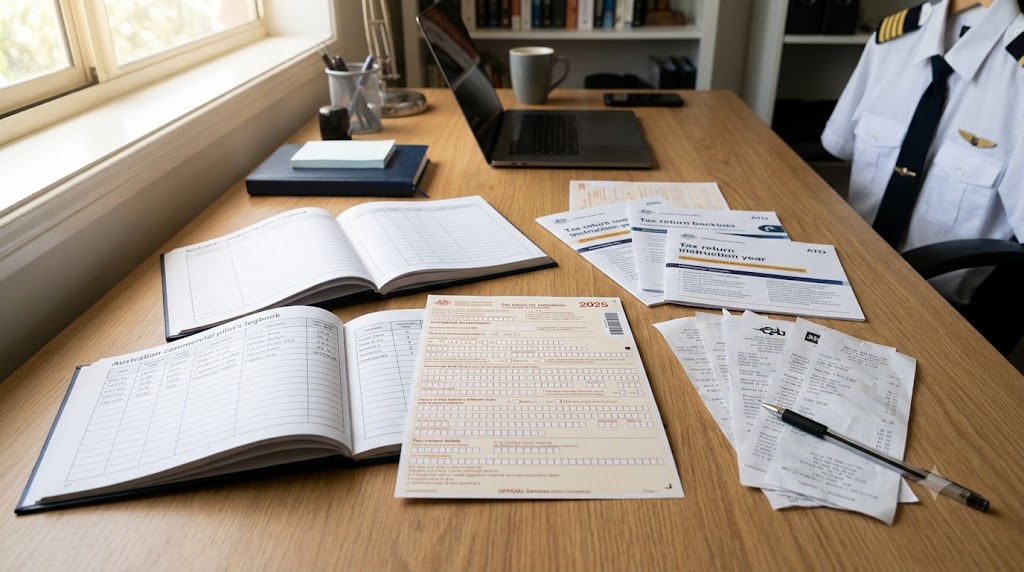
Most pilot tax guides read like a wishlist of everything you could possibly claim. The problem is that they ignore the document sitting underneath your pay: the Air Pilots Award 2020 (MA000046). The award is stuffed with employer-paid allowances and reimbursements, and the single most important tax rule for a pilot — you can't claim what you weren't out of pocket for — runs straight into it. So before you claim a cent, the real question isn't "what can a pilot deduct?" It's "what did I actually pay for myself?"
Allowance versus reimbursement — get this right first
A reimbursement repays an exact cost — you were made whole, so there is nothing to deduct. An allowance is a set amount paid to cover an expected cost: it's assessable income you must declare, and you can then claim only what you genuinely spent. You never claim the allowance figure itself, and you can't claim anything your employer has fully reimbursed.
Hold that lens over every expense, alongside the ATO's three golden rules: you spent the money and weren't reimbursed, it directly relates to earning your income, and you have a record to prove it.
Training, endorsements and licences
This is where the generic advice goes most wrong for award-covered pilots. Yes, self-education that improves the skills of your current flying job is deductible in principle — but the award means you rarely pay for it. Type ratings and recurrent training are typically employer-funded, and where an employer directs you to train, clause 13.6 forbids them from even bonding you for it. Pre-employment training you had to fund is reimbursed under clause 13.5, and on termination clause 33.6 entitles you to be trained or reimbursed to maintain your required licence and rating. If the employer paid, you claim nothing.
You can still get a deduction where you genuinely carry the cost yourself — a training bond that recovers up to 50% of a type rating if you leave early, or a course you self-fund to lift your current role. Firmly non-deductible is the initial climb into the industry — your first CPL, ATPL subjects, the hours you bought before anyone employed you as a pilot. You weren't yet earning a pilot's income, so it fails the test, and getting hired later in the same financial year doesn't reach back and change it.
And the licence allowances themselves are salary, not expenses. The ATPL allowance — $6,763.17 a year for aeroplane pilots (clause A.1.3(b)), or $5,766.61 for helicopter pilots (clause D.4.1(a)) — along with the $8,196.42 command instrument-rating allowance (clause A.1.4) and the turbo-prop and turbo-jet additions, are all taxable income in your hand, not a deduction. (Award figures index with each annual wage review from 1 July — check the current schedule.)
Uniforms and laundry
This is the example that shows why the award matters. If your employer provides the uniform, you paid nothing and claim nothing. If they require a uniform but don't provide one, they must pay a uniform allowance of $284.97 on employment and annually (clause 20.3(e)(ii)). And if they don't supply protective clothing and equipment, clause 20.3(e)(iv) says they must reimburse the reasonable cost of both purchase and maintenance.
So the laundry claim so many guides trot out is often dead on arrival. Where protective gear's maintenance is reimbursed, you can't claim laundering it. Where you receive the $284.97 allowance, declare it as income and claim only your real outlay on buying and washing the compulsory uniform — $1 per work-only load (50c mixed), no receipts needed under $150 of laundry, though you must show your working. Conventional clothing is never deductible — the ATO's pilot guidance singles out plain black pants, ordinary shoes, business attire, even clothes bought to look like a passenger when paxing. One exception: shoes whose exact characteristics a strictly enforced uniform policy prescribes.
The medical: the one they don't pay
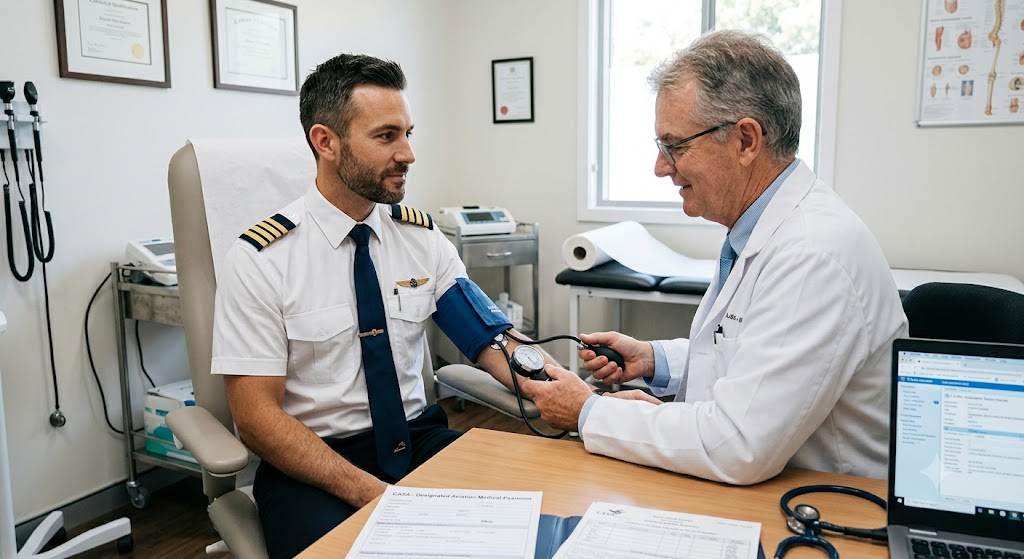
Here's the standout item, and the reason cross-checking the award pays off. Nowhere does MA000046 oblige your employer to fund your aviation medical. That cost is genuinely yours — so the fee you pay a Designated Aviation Medical Examiner to renew the Class 1 medical your job depends on is a legitimate deduction while you're employed as a pilot; the ATO's pilot guide says so explicitly. The same goes for licence, rating and ASIC renewals you fund yourself — renewals only; the initial licence never. It's the rare big-ticket item the award leaves in your pocket.
The ATO's own pilot list — including the odd ones
The ATO publishes an occupation guide and tax-time poster specifically for pilots, with rulings worth knowing before your agent asks:
Generally claimable (if you paid)
- CASA-required medical examinations
- Anti-glare glasses used to counter cockpit glare
- Rehydrating moisturiser and hair conditioner (dry cabin air)
- Luggage and nav bags used for work — immediate deduction under $300, depreciated above
- Licence, rating and regulatory renewals (never the initial issue)
- Union and professional association fees
- Work-required visa applications and fees
- Headsets, EFB hardware and chart/app subscriptions (work portion)
- Phone and internet, apportioned for work use
- Home study and admin at 70c per hour (2025–26 fixed rate)
Explicitly not claimable
- Watches — including chronographs, however aviation-flavoured
- Flight simulator games and gaming consoles
- Prescription glasses and contact lenses (private)
- Flu shots and other vaccinations
- Mobile phone holders for the aircraft
- Grooming, haircuts and ordinary sunscreen (aircraft-dependent nuances aside)
- Parking at your regular workplace; tolls on the commute
- Meals and snacks on duty days where you sleep at home — even if you received an allowance
Meals, layovers and getting around
For pilots the award covers, meal claims largely evaporate. Under clause 20.3(a) a layover away from home base has your accommodation and meals reimbursed in full, plus a $28.72 nightly allowance (clause 20.3(a)(ii)); extended duty over a meal period pays set meal allowances. Because the meals are reimbursed, you can't claim them — only genuine, unreimbursed incidentals covered by the allowance. Note too that clause 20.3(a) doesn't apply to regional-airline or helicopter crew, who sit under enterprise agreements that usually do something similar.
Where you do pay your own way overnight — the ATO defines that as a mandatory rest break long enough to sleep, around seven hours, normally with accommodation — genuine meal, accommodation and incidental costs are claimable, with the Commissioner's reasonable amounts (TD 2025/4 for 2025–26) as a record-keeping safe harbour when an allowance was paid. Two traps: an allowance never entitles you to a deduction by itself, and six or more consecutive nights away requires a travel diary. Day-return flying kills the meal claim entirely, allowance or not.
Travel is the same story. Duty travel must be provided at no expense to you (clause 20.3(b)); drive your own car for duties with approval and the employer pays $1.00 per kilometre (clause 20.3(b)(v)) — more than the ATO's 88 cents for 2025–26, and those kilometres aren't separately claimable. The commute was never deductible anyway: the ATO's pilot guide specifically notes that travel from home to your usual sign-on point is private, even living in Melbourne and signing on in Newcastle. What you can claim: driving between two jobs on the same day, or from home to an alternative workplace like the training centre.
Insurance, phone, union fees and genuine gear
Clause 20.3(c) has your employer contributing up to $3,092 a year toward loss-of-licence insurance on production of proof — so you can only deduct a premium to the extent you actually bear it, and only where the benefit would be taxable. Income-protection premiums you pay personally outside super remain deductible in the ordinary way. The telephone allowance in clause 20.3(d) covers work calls and part of your line. What stays cleanly deductible is what you truly self-fund: union and association fees, a headset, flight bag, EFB and its subscription, anti-glare sunglasses, and study or work admin from home at 70 cents an hour for 2025–26 — each apportioned for private use, with depreciation over the effective life for any item over $300.
The income side: where the real money hides
Deductions get the attention, but for most pilots the bigger tax levers sit on the income side. Superannuation first: the concessional cap is $30,000 for 2025–26, and if your total super balance is under $500,000 you can also use unused cap space carried forward from the previous five years — tailor-made for the pilot whose income just jumped from GA money to a jet salary (lodge the notice-of-intent form before claiming). From 1 July 2026 the cap rises to $32,500. Captains clearing $250,000 should expect Division 293's extra 15% on concessional contributions, and anyone without private hospital cover should check the Medicare levy surcharge thresholds.
Two timing notes: your FY2025–26 return uses the old rates (16% first bracket) — the legislated 15% cut applies from 1 July 2026, showing up in this year's take-home pay, not last year's refund. And HELP repayments are calculated on repayment income, which counts salary packaging and reportable super contributions.
Tax-time tactics
A few habits separate a clean, maximised return from an audit magnet. Don't lodge in the first fortnight of July — wait until your income statement is "tax ready" and pre-fill lands, because allowances report through STP and mismatches invite questions. Keep records as you go (the ATO's myDeductions app works well); receipts must survive five years, and the $300 no-receipt threshold is not a free kick — you still must have spent the money. Around 30 June, use the 12-month prepayment rule: prepaying next year's loss-of-licence or income-protection premium, union fees or EFB subscription brings the deduction forward, as does an early DAME renewal or self-funded IPC. And know the ATO data-matches aviation employers' allowances — the pilot claiming meals against a fully reimbursed layover pattern is exactly the return their models flag.
Special situations
Three brief flags. Regional and EBA pilots: your enterprise agreement overrides much of the award detail above — run the same allowance-versus-reimbursement lens over its clauses. Remote-based pilots: the zone tax offset survives for those whose usual residence is genuinely in a remote zone for more than half the year — but since 2015, FIFO crews living in Perth or Cairns and merely working in the zone don't qualify. Flying overseas: once an expat contract appears, tax residency becomes the whole game and dwarfs every deduction here — have that conversation with a specialist agent before you sign, not after you land.
The bottom line
For an award-covered pilot, honest tax is mostly subtraction. Declare every allowance as income, strike out everything the employer provided or reimbursed, and claim only what you were genuinely out of pocket for — the medical above all, plus the quiet list the ATO itself publishes: renewals, union fees, the nav bag, the anti-glare sunglasses, even the moisturiser. Then do the income side properly — super caps, carry-forward, the right timing around 30 June — because that's where the dollars are bigger than any laundry claim. And don't claim a hotel your roster already paid for.
Further reading
- ATO — Pilots: income and work-related deductions — the ATO's occupation-specific guide covering allowances, uniforms, medicals, travel and equipment for pilots.
- ATO — Tax Time toolkit: Pilot (PDF) — the one-page summary of what pilots can and can't claim.
- ATO — Overnight travel expenses and allowances — rules for claiming travel allowance expenses when travelling away from home overnight for work.
- TD 2025/4 — Reasonable travel and overtime meal allowance expense amounts (2025–26) — the Commissioner's "reasonable amount" safe-harbour figures for accommodation, meals and incidentals.
- ATO — Superannuation contributions caps — current concessional and non-concessional caps and the carry-forward rules.
- Air Pilots Award 2020 (MA000046) — the full text of the award, including allowance rates, reimbursement obligations and training provisions referenced throughout this article.
This article is general information current as at July 2026 and reflects the Air Pilots Award 2020 (MA000046) and ATO guidance at the time of writing; it is not personal tax, financial or industrial advice, and your circumstances may differ. Award rates and tax thresholds change every year. Before acting, check ato.gov.au and your award or enterprise agreement, or speak to a registered tax agent. Not affiliated with CASA or the ATO.