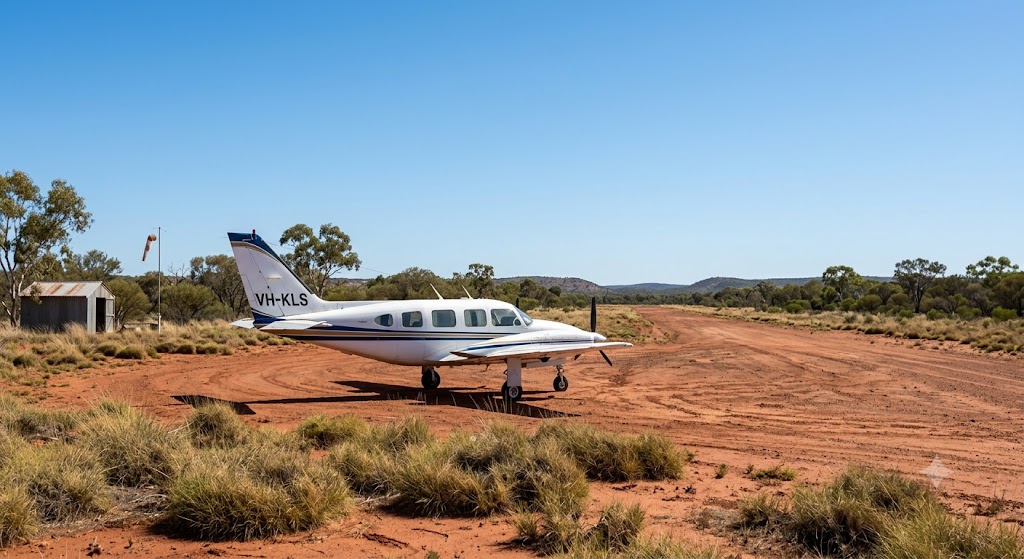
Most of Australia doesn't have a certified aerodrome. It has red-dirt station strips, grass paddocks, mining pads, beaches and the occasional stretch of highway — and that is where a huge share of this country's real flying actually happens. These are Aircraft Landing Areas, or ALAs: places other than a certified aerodrome where you take off and land under Part 91. The freedom is extraordinary. So is the shift in responsibility.
Who says it's okay? (the paperwork, part one)
There is no CASA "licence" for an ALA and no inspector who signs it off. Under Part 91, the burden sits squarely on the pilot in command: you must be satisfied the place is suitable for the aircraft, the conditions and the operation before you commit to it. CASA's guidance lives in Advisory Circular AC 91-02, "suitable places to take off and land," for aeroplanes up to 5,700 kg — the document that replaced the old CAAP 92-1 when Part 91 came in. Helicopters have their own equivalent. These are guidelines, not a tick-and-forget checklist, and they exist to help you make the call, not to make it for you.
If you're flying private, that judgement is yours alone. The moment passengers are paying — charter and other Part 135 work — the operator inherits a stack of extra duties. The ALA has to be assessed and authorised, listed in the operations manual, usually backed by a written risk assessment, and frequently subject to landowner permission and an annual review. Plenty of operators keep a formal ALA register with a proforma for each site: dimensions, hazards, one-way notes, tide tables, a photo. That paperwork isn't bureaucracy for its own sake — it's the difference between a considered operation and a good guess, and it's the first thing an insurer and the ATSB will ask for if it goes wrong.
The assessment
Start with the numbers. Is the strip long enough for your aircraft on the day — not on a cool morning at sea level, but hot, high, and loaded, off grass that's soft or a surface that's rough? Take your flight manual figures and add honest margins: a wet or grassy surface can stretch a ground roll dramatically, and a slope changes everything. Many bush strips are one-way, meaning you land uphill and take off downhill regardless of the wind, because the gradient matters more than a light tailwind.
Then the surface and the surrounds. Look for ruts, holes, loose stones that will sandblast a prop, bulldust that hides them all, boggy patches after rain, and anything that could snag a wheel. Check the approach and departure paths for obstacles — the guidance works to a rough one-in-twenty splay off each end, an obstacle-clearance funnel you need to keep clean. The trap is that a strip looks perfect from 500 feet on downwind and reveals its ruts and washouts only when you're committed. Where you can, inspect it properly: an overflight and a low pass at least, and on the ground on foot or by vehicle if the operation allows. And if it's a beach — K'gari's 75 Mile Beach is the famous one, classed as both a highway and a runway and worked daily by operators like Air Fraser Island — the strip you assessed at low tide simply isn't there at high tide. The rule of thumb is to stay off it within roughly two hours either side of the high.
The risks
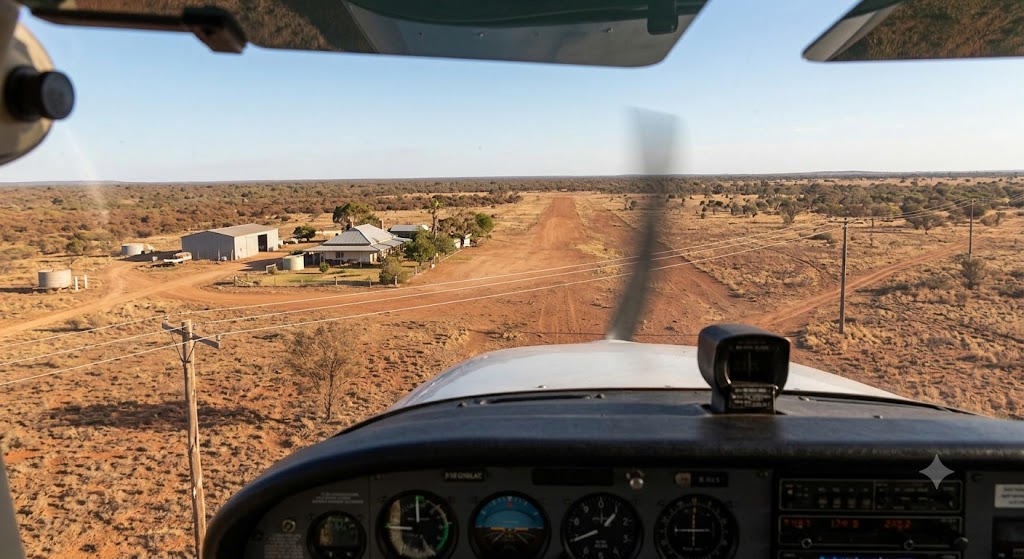
Wires. Powerlines and single-strand fence wires strung across an approach or along a boundary are almost invisible from the air. If you don't know for certain a wire isn't there, plan as though it is.
After wires come the living hazards. Kangaroos drifting onto a strip at dawn and dusk, cattle through a broken fence, and birds lifting off a dam are all part of outback arrivals — which is exactly why you clear the area before committing and why a go-around has to be a live option right to the flare. Then the surface risks: bogging after rain, a prop strike from stones, a tail strike on an unexpected hump. Then the environment: density altitude that quietly steals your climb on a 40-degree afternoon, terrain that funnels the wind and rolls turbulence off the ridgelines, and the simple fact that an ALA offers none of the comforts of an aerodrome — no fuel, no fire service, no weather report, no lighting, and often no phone signal to call for help.
Night multiplies all of it, which is why the improvised solutions are the stuff of legend. When the Royal Flying Doctor Service is called to an unlit strip in an emergency, communities have lined the runway with anything that burns — kerosene flares, LED lanterns, and famously, rolls of toilet paper soaked in fuel and set alight. Procedures call for those lights to stay burning for thirty minutes after the aircraft leaves, in case it has to come straight back. And when there's no strip at all, the RFDS lands on the road: sections of outback highway like the Silver City Highway north of Broken Hill double as runways, with the local police parked at each end to hold the traffic. It's magnificent, and it's a reminder that these operations are planned and coordinated, not improvised on a whim.
Before you go (the paperwork, part two)
The homework happens on the ground. Check NOTAMs — a strip won't be in ERSA, but temporary hazards and closures still get published. Get the landowner's permission and, with it, the local knowledge: which end floods, where the new fence went in, when they last graded it. Run your weight and performance for the actual conditions and write the numbers down. Have a plan B — the nearest sealed alternate, the fuel to reach it, and a clear line in the sand for when you'll walk away. If you're operating commercially, that means the ALA is authorised, in the manual, and current. If you're private, it means you've done the same thinking without anyone forcing you to.
The bottom line
A certified aerodrome does the thinking for you. An ALA hands it back, and that's the whole point — it's where flying stops being a procedure and becomes airmanship again. The strips that open up this continent, from a cattle station in the Kimberley to a beach on K'gari, reward the pilot who assesses honestly, respects the wires and the tides and the density altitude, and keeps the go-around in their back pocket. Do the work on the ground, and the ALA becomes the best part of the job rather than the last mistake you make.
This article is general information and is not a substitute for current CASA guidance, your operations manual, or a proper site assessment. Always consult AC 91-02 and your operator's procedures before operating into any ALA. Published in June 2026. Not affiliated with CASA.