The job description never mentions it, but every airline pilot eventually learns the truth: the hardest part of the lifestyle isn't the flying. It's the 4:50am sign-on with nothing open but a servo, the crew room where the only food group is the biscuit tin, the hotel arrival at 10pm when room service has closed and the pub across the road is doing parmas the size of a main wheel. Eat and move like the roster wants you to, and within a few years the belt and the Class 1 medical both start feeling tighter.
The research is blunt about it. Reviews of airline pilot health consistently link the occupation's mix of shift work, disrupted eating, sedentary duty and broken sleep to elevated rates of overweight, cardiovascular risk and metabolic problems — and, in the short term, to the thing that matters most at 200 feet in driving rain: fatigue. Poor eating and mild dehydration measurably degrade alertness and cognitive performance. Your body is operational equipment. It deserves the same maintenance schedule as the aircraft.
The good news is that staying healthy on the road doesn't require a chef or a gym membership in every port. It requires a handful of habits, applied with the same discipline you already bring to a pre-flight.
Don't leave food to chance
The single most effective change any pilot can make is deciding what they'll eat before the duty starts. Left to chance, the roster will decide for you, and the roster's menu is vending machines, terminal fast food and whatever the overnight port offers — which, in plenty of Australian regional towns, is a bakery, a servo and a Chinese restaurant that closed twenty minutes ago.
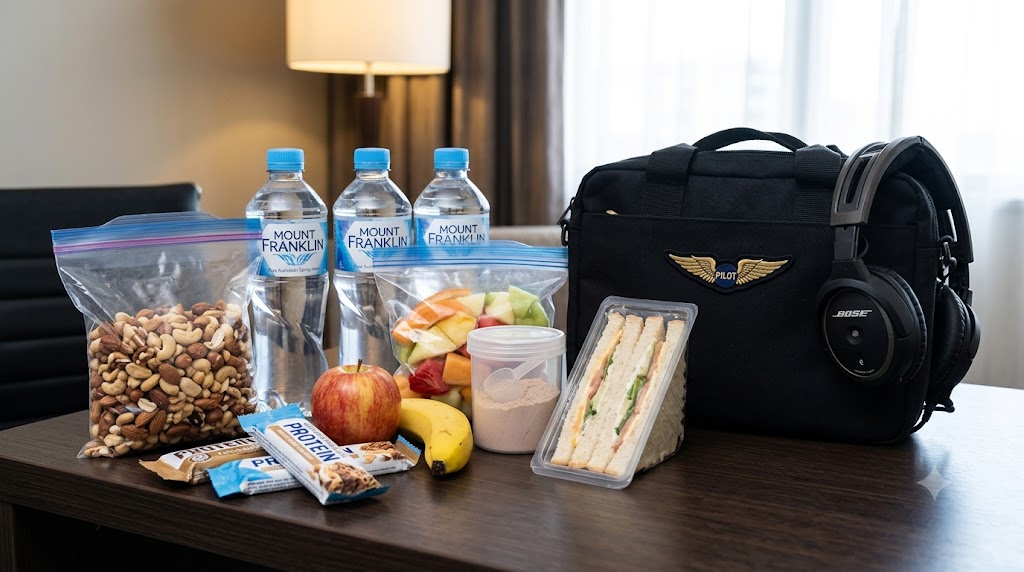
So pack food the way you pack charts. A flight-bag kit costs little and travels well: oats or muesli in zip-lock bags, nuts and trail mix, tuna or salmon pouches, protein bars with a short ingredient list, fruit that survives a nav bag (apples, mandarins), and a small tub of protein powder that turns hotel-room milk into a recovery meal. On multi-day trips, make the supermarket your first stop after checking in — ten minutes buys breakfast, snacks and a backup dinner for less than one room-service burger. Hotel breakfast can work for you rather than against you: eggs, yoghurt, fruit and wholegrain toast are almost always on the buffet, hiding behind the hash browns.
Eat with your body clock, not against it
Nutrition on the road isn't just what you eat — it's when. Human metabolism runs on a circadian schedule: insulin sensitivity falls away overnight, so the same meal eaten at 2am produces a higher blood-glucose response than it would at 2pm. That's one reason shift workers show higher rates of gastrointestinal trouble, weight gain and type 2 diabetes. Your digestive system, like the rest of you, thinks it should be asleep in the early hours.
The practical rules that dietitians give night-shift workers translate directly to flying. Keep your meal pattern anchored to normal daytime rhythm as much as the roster allows — three meals per 24 hours, at roughly consistent times. On overnight duties, eat your main meal before the duty rather than during it, then keep intake between about midnight and 6am light: small, protein-based snacks rather than a heavy tray at the top of descent. Avoid rich, fatty or fried food in the back half of a night duty — it sits like ballast and deepens the pre-dawn slump. And after a night duty, resist the celebratory big breakfast; a light, easy-to-digest meal helps you get to sleep instead of lying awake digesting.
On long duty days, graze deliberately. Small, regular snacks combining protein and low-GI carbohydrate keep blood sugar — and alertness — stable in a way the sausage roll and iced coffee at the terminal never will. The sugar spike always sends an invoice, and it arrives about an hour later, usually somewhere around top of descent.
Hydrate like it's a checklist item
Cabin air is drier than most deserts — relative humidity in flight can sit below 10–20 per cent — and you lose moisture continuously through skin and breath without noticing. The catch is that even mild dehydration impairs concentration, degrades mood and amplifies fatigue, which makes water a flight-safety item, not a comfort item.
Make it procedural. Carry a bottle, refill it at every opportunity, and aim for two to two-and-a-half litres across a duty day — more in the tropical north or a summer westerly. Pair your caffeine: a glass of water alongside every coffee, because caffeine is a diuretic and flight decks run on it. Use caffeine tactically, too — early in the duty or before the demanding sector, not on a continuous drip, and cut it off six to eight hours before planned sleep or it will quietly sabotage the layover rest you're relying on.
Alcohol deserves its own line item. Beyond the DAMP and bottle-to-throttle rules every Australian pilot already knows, the sleep science is unambiguous: alcohol fragments sleep and strips out its restorative quality, so the two quiet beers that "help you wind down" actually hand tomorrow's sector a poorer version of you. On the road, treat it as an occasional, early-evening choice — not a nightly routine.
Move consistently, not heroically

Consistency beats intensity, every time. The pilot who plans an hour in the gym every layover does it twice and quits. The pilot who commits to fifteen minutes, every day, wherever they wake up, stays fit for a career.
Build a routine that needs nothing. A bodyweight circuit — squats, push-ups, lunges, plank, repeated for fifteen minutes — works in any hotel room, including the ones where the "gym" is a broken exercise bike facing a wall. A resistance band weighs nothing, lives permanently in the flight bag, and covers rows, presses and pull-aparts that undo a day in an aircraft seat. Four minutes of Tabata intervals (twenty seconds hard, ten seconds rest, eight rounds) will do more than most people manage at home. And never underestimate walking: exploring a layover town on foot is exercise, sunlight for the body clock, and mental health rolled into one. The only timing caveat — finish vigorous exercise a few hours before sleep, or it joins caffeine on the list of self-inflicted insomnia.
Guard the third pillar
Food and exercise stand on a foundation of sleep, and on the road all three rise and fall together. Keep the basics ruthless: room cool and genuinely dark (pack tape or a peg for the curtain gap), phone away, caffeine cut-off honoured. Short naps of twenty to thirty minutes before a night duty are one of the best-evidenced fatigue countermeasures in aviation. If you're regularly lying awake in hotel rooms, treat it as a maintenance issue worth fixing, not a personality trait — the Sleep Health Foundation's shift-work resources are a good starting point.
Make it stick
None of this survives on willpower — it survives on routine. Attach the habits to ones you already have: packing the flight bag means packing the food kit; checking in means finding the supermarket; the overnight bag always contains the band and the runners. Order first at crew dinners so the table doesn't decide for you. And aim for consistency, not sainthood: the 80 per cent solution, flown every trip, beats the perfect week that never happens. You run your aircraft on a maintenance schedule. Run yourself on one too — your medical, your alertness and your retirement will all thank you.
Further reading
- CASA — Pilot health and wellbeing — the regulator's hub for pilot health, wellbeing and support services.
- CASA — Fatigue management — rules, guidance and fatigue resources for Australian operations.
- Sleep Health Foundation — Shift work and Healthy sleep practices for shift workers — evidence-based Australian sleep guidance.
- Healthy Nutrition, Physical Activity, and Sleep Hygiene to Promote Cardiometabolic Health of Airline Pilots — narrative review; the research picture on pilot health, in one place.
- Combined healthy eating, physical activity and sleep intervention for overweight airline pilots — controlled trial; proof that modest lifestyle changes work in this occupation.
- NIOSH — Diet suggestions for night-shift workers — practical chrononutrition advice that maps neatly onto flying.
- Flight Safety Australia — Managing the risks of workplace fatigue — fatigue risk through an Australian aviation lens.