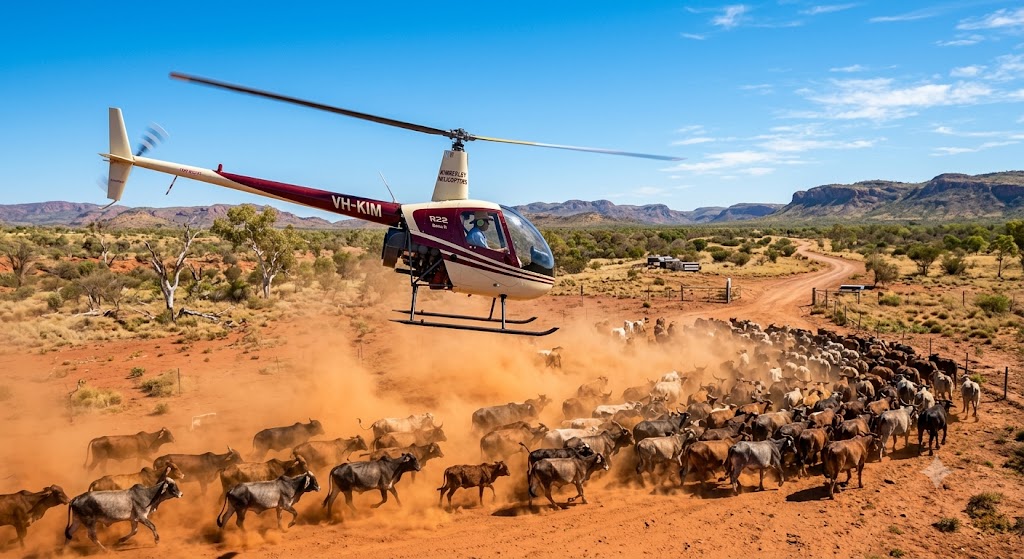
Ask a room full of helicopter pilots how they got their jobs and you'll hear a dozen different stories — cattle stations in the Kimberley, reef tours out of Cairns, seasons chasing fires in Victoria, oil rigs off Karratha, night winch jobs over the Tasman. Rotary-wing aviation has no single ladder. It has a web of pathways, and Australia — with its cattle country, coastline, resource industry and fire seasons — happens to be one of the best places on earth to climb through it.
It's also a good moment to be starting. The global helicopter industry is running short of pilots: more than 2,000 offshore pilots worldwide are reaching retirement age by 2026, training academies have been reporting enrolment shortfalls against demand, and the long-standing pipeline of ex-military aviators into civilian jobs has thinned. Demand in emergency medical services, offshore transport, firefighting and tourism is as strong as it has been in decades. None of that makes the first job easy to land — rotary aviation has never handed out free rides — but the horizon beyond it has rarely looked better.
Step one: the licence
Everything starts with the Commercial Pilot Licence (Helicopter) — the CPL(H). Under CASA's rules you'll need a minimum of 105 hours of helicopter flight training through an approved school, a Class 1 aviation medical, and passes in seven CPL(H) theory exams covering aerodynamics, systems, performance, meteorology, navigation, human factors and air law. Most students train on the two-seat Robinson R22 — still the workhorse of Australian training and mustering — or the Cabri G2, with some schools offering the four-seat R44 for a price premium.
And price is the honest headline: a CPL(H) in Australia typically costs somewhere between $100,000 and $125,000 depending on school, aircraft and how efficiently you progress. Industry surveys consistently rank cost as the single biggest barrier to entry into helicopter careers, so go in with clear eyes and a plan. There are ways to soften the blow. Several schools deliver the licence inside the AVI50322 Diploma of Aviation, which makes eligible students able to access VET Student Loans — TAFE Queensland runs diploma programs, and schools such as Aeropower Flight School (Brisbane and Sydney) offer VSL-eligible full-time courses. Other established names around the country include the Australian Helicopter Pilot School, V2 Helicopters with Flight One in Queensland, Townsville Helicopters, and specialist theory providers like Utility Helicopters. Visit more than one school before you sign anything, fly an introductory lesson, and ask the question that matters most: where are your recent graduates working now?
The catch-22, and the Australian answers to it
Every newly minted 105-hour CPL(H) holder meets the same wall: operators want experience, and experience requires a job. The good news is that Australia offers more genuine low-hour pathways than almost anywhere else in the world. Four of them have carried generations of pilots through their first thousand hours.
The northern apprenticeship: mustering. Helicopter mustering — working cattle across the vast stations of the Kimberley, the Territory and outback Queensland in an R22 — is the classic Australian rotary apprenticeship, and it remains the fastest hour-building of any entry job. It is also earned, not given.
Most mustering operators hire attitude before logbook hours. The standard route in is a ground job first — driving loaders, fixing fences, working cattle in the yards — and prove you're worth training. Operators hire reliability long before they hire logbooks, and the flying seat follows.
To fly the job itself you'll need a low-level rating and a mustering endorsement (a minimum of five hours' training plus a flight test, usually conducted in the field). What mustering gives you in return is gold: precise low-level handling, real decision-making, engine-out awareness drilled daily, and several hundred hours a season through the dry, April to October. What it costs you is remoteness, heat, long weeks and modest pay. Most pilots who've done it wouldn't trade the education for anything.
Tourism. Scenic flying is the other great entry door — the Great Barrier Reef from Cairns and the Whitsundays, the Twelve Apostles, Uluru, the Gold Coast and Sydney Harbour all support fleets of R44s, EC120s and H130s doing high-cycle scenic work. Tourism builds hours steadily, teaches immaculate passenger handling and radio discipline in busy airspace, and polishes the customer-facing professionalism that later employers in EMS and charter quietly prize. Competition for these seats is real, and many operators like to grow their own — more than a few reef pilots started on the ground loading passengers and fuel.
Instructing. Adding a Grade 3 instructor rating after your CPL(H) lets you build hours teaching at the school that trained you — the standard path in North America and an increasingly common one here. It suits pilots who communicate well, and it compounds: instructing forces you to actually understand everything you were taught, which pays off in every interview that follows.
Utility odd jobs. Aerial photography and film work, survey and mapping, powerline inspection, scenic charter, frost fans and crop work all absorb junior pilots in ones and twos. These jobs rarely advertise; they go to pilots who are known. Which is the first career lesson of Australian rotary aviation: it is a small industry, everyone knows everyone, and your reputation begins on day one of flying school.
Building the middle of the logbook
Between the first job and the big machines lies the phase where you deliberately collect capability. Each rating opens a new class of work: the low-level rating and sling/longline training unlock utility and fire support; an agricultural rating opens spraying and spreading; night VFR extends your usefulness; a turbine engine endorsement — often the JetRanger or AS350 Squirrel — marks the single biggest step up in employability; and eventually multi-engine and command instrument ratings open the door to the two-crew IFR world of offshore and EMS. Vertical-reference longline skill, in particular, is the currency of the utility and firefighting sector, and pilots who can place a load on a pin in wind are never unemployed for long.
Plan the sequence rather than collecting ratings at random. Look at the minimum requirements on job ads for the sector you're aiming at — they are published openly — and work backwards. A pilot targeting EMS needs command turbine time, instrument currency and ideally night and winch exposure; a pilot targeting fire needs low-level, sling and Squirrel/205-class turbine time; a pilot targeting offshore needs multi-engine IFR and disciplined multi-crew habits.
The big leagues
Firefighting. Australia's fire seasons have made aerial firefighting a major employer, from light helicopters on reconnaissance and crew insertion to medium and heavy machines on the hose and bucket. Kestrel Aviation at Mangalore in Victoria and Queensland's McDermott Aviation — whose Bell 214 fleet is a fixture of Australian summers and overseas contracts alike — are two of the biggest names, alongside a spread of utility operators who take state contracts each season. Fire work is seasonal, intense and well paid, and many Australian pilots build a year-round career by chasing winters: Australian summer on contract here, northern-hemisphere summer in Canada, the US or the Mediterranean.
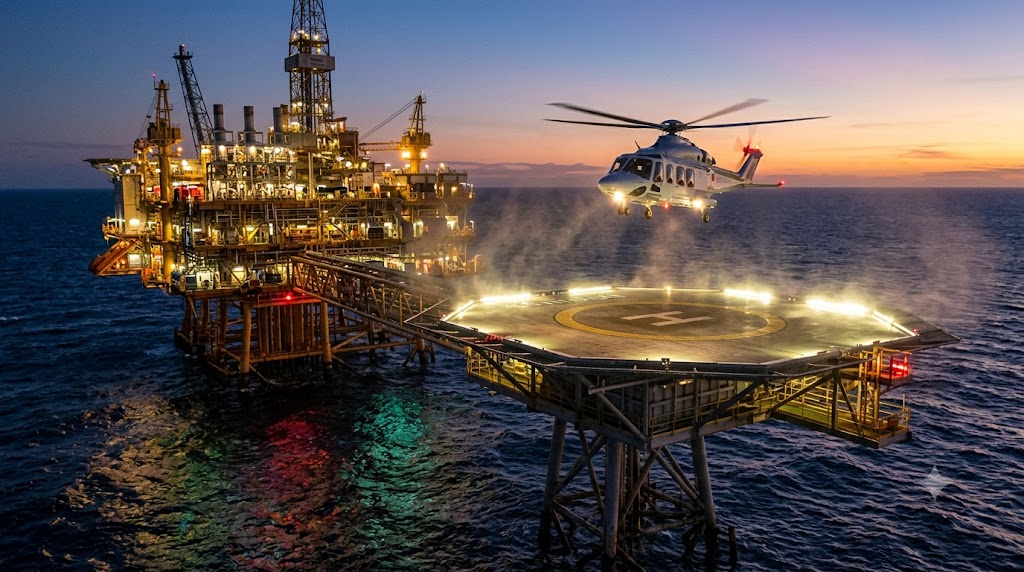
Offshore oil and gas. The offshore sector is rotary aviation's airline: large twin-engine machines — AW139s, S-92s — flown two-crew under IFR to platforms and floating facilities, with airline-grade rostering, simulators, checking and safety systems. The Australian industry concentrates in the north-west (Perth, Karratha, Broome, Darwin) with Bass Strait work in the south-east, and the operators are global names: CHC Helicopter — which holds a nine-year contract with Woodside reported at around half a billion dollars, among the largest helicopter contracts ever written in Australia — alongside Bristow, whose Australian history stretches back to the late 1960s, PHI and Babcock. Entry requirements are the steepest in the industry — think multi-engine command instrument rating, solid turbine command time and often prior multi-crew experience — but the salaries, rosters (commonly touring or FIFO patterns) and job stability sit at the top of the profession.
Emergency medical services and search and rescue. For many pilots HEMS/SAR is the summit: night winching off a pitching deck, NVIS approaches to a highway accident, hospital rooftops in weather. Australia runs one of the world's most capable networks — RACQ LifeFlight Rescue flying AW139s from seven Queensland bases, the Westpac Rescue Helicopter Service in NSW, CareFlight in Sydney (the country's first operator of the EMS-configured Airbus H145) and the Northern Territory, plus state ambulance and rescue contracts flown by major operators around the country, and police air wings in most capitals. Requirements typically include thousands of hours of command turbine time, instrument and NVIS qualifications and winch experience, which is why EMS is a destination rather than a starting point. If it's the dream, build toward it deliberately through utility, offshore or military flying — the sector recruits heavily from all three.
The military option
There is one pathway that inverts the whole economic problem: let the Commonwealth pay. The Australian Defence Force trains Army and Navy helicopter pilots through the Helicopter Aircrew Training System (HATS) at HMAS Albatross in Nowra, a joint school with capacity to train up to 144 pilots and aircrew annually. Entry is via officer selection — strong candidates can be offered an Aviation Cadetship — and the flying that follows (Taipan-replacement Black Hawks, Apaches, MRH and Seahawk maritime work) is some of the most demanding rotary aviation there is. The trade-off is a return-of-service obligation measured in years and a career that belongs to Defence while you're in it. But ex-ADF pilots transition into civilian HEMS, SAR and offshore roles with instant credibility, and Defence's transition programs formally recognise military competencies toward civil qualifications. If you're young, fit and academically solid, it deserves serious consideration alongside the civil route.
The view from overseas
Australian helicopter careers have always had a global chapter. Papua New Guinea's utility scene has long been a proving ground for Australian longline pilots; New Zealand offers ag and alpine work; Canada's utility and heli-ski industry recruits southern-hemisphere pilots for its summer; the North Sea and Gulf of Mexico remain the world's two great offshore basins for those willing to convert licences. And a genuinely new market is emerging: offshore wind. Global offshore wind capacity is forecast to grow roughly fifteen-fold over the next two decades, and helicopters are indispensable for servicing far-offshore turbine fields — already a major employer of pilots in Europe, and a plausible future sector here as Australia's declared offshore wind zones develop. The through-line in all of it: the skills Australia teaches — low-level discipline from mustering, vertical reference from utility, multi-crew IFR from offshore — are portable everywhere helicopters fly.
What it pays
Honest numbers, in broad strokes. Entry-level mustering and tourism flying is modestly paid — often accommodation-and-board territory in the north, or wages in the $60,000–90,000 range in tourism. Mid-career utility, ag and fire pilots with sling and low-level skills commonly earn six figures, with experienced fire captains well beyond that in a busy season. At the top, multi-crew captains in offshore and EMS sit in the $150,000–200,000-plus bracket in Australia, with overseas offshore and specialist utility contracts capable of more. Set against a $100,000-plus training bill, the early years are lean and the later years are good — which is exactly why the pilots who thrive are the ones who treated the first five years as an apprenticeship rather than a payday.
Final approach
If there's a single theme running through every helicopter career in this country, it's this: the industry hires people first and logbooks second. It is small enough that reputations travel faster than résumés — the pilot who worked hard on the ground, kept the hangar swept, turned up early and flew conservatively gets the call when a seat opens. So choose a school that's connected to real operators, spend your money deliberately, go north when the chance comes, collect ratings with a destination in mind, and guard your safety record like the career asset it is. The machines get bigger, the missions get sharper, and the web of pathways keeps opening — mustering to fire, tourism to EMS, Nowra to the North Sea. There has rarely been a better time to start climbing.
Further reading
- CASA — CPL(H) theory exams — the official word on licensing and examinations.
- Barossa Helicopters — So, You Want to Be a Helicopter Pilot in Australia? — a candid operator's view of the early career.
- Australian Helicopter Pilot School — Helicopter pilot careers — sector-by-sector career overview from a training organisation.
- Australian Flying — Helicopter guide — industry overview including the path to offshore and EMS flying.
- TAFE Queensland — Diploma of Aviation CPL(H) and Aeropower Flight School — examples of diploma and VSL-linked training routes.
- ADF Careers — Army Helicopter Pilot and Defence — Helicopter Aircrew Training System — the military pathway.
- AirMed&Rescue — Provider profile: LifeFlight Australia — inside one of Australia's biggest HEMS operations.
- Pilot Institute — Helicopter pilot salary guide — pay benchmarks across EMS, utility, tours and offshore.
- Helijobs.net — current rotary vacancies worldwide, including Australian mustering and utility roles.
This article is general information current as at July 2026. Training costs, salary benchmarks, school offerings, operator details and regulatory requirements change regularly — verify current information directly with CASA, training organisations and operators before making any decisions. Published in June 2026. Not affiliated with CASA or any training provider, operator or organisation mentioned.