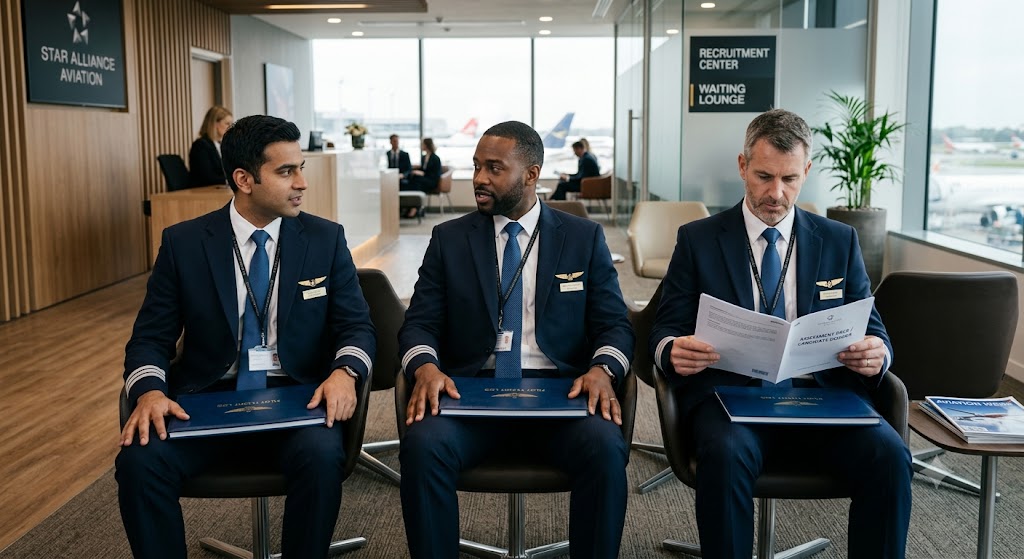
There is a particular kind of silence in the waiting room outside an airline assessment centre. A handful of pilots in freshly pressed suits, logbooks on laps, all quietly aware that the next few hours may decide the trajectory of a career built over thousands of hours of instructing, charter, freight or regional flying. The airline interview is the narrowest gate in professional aviation — and yet it remains one of the most misunderstood.
The good news for anyone facing that gate in 2026 is twofold. First, the demand side of the equation has rarely looked better. Boeing's latest Pilot and Technician Outlook forecasts around 660,000 new pilots will be needed worldwide over the next twenty years, part of nearly 2.4 million new aviation professionals through 2044. In Australia, every major operator is recruiting: Qantas is deep into a generational fleet renewal with Project Sunrise ultra-long-haul flying now visible on the horizon, Virgin Australia is growing again after its post-administration rebuild, Jetstar continues to expand, and Rex — having emerged from administration under new ownership in late 2025 — is rebuilding its Saab 340 regional network. Second, and less appreciated: the airline interview is not a mysterious personality contest. It is a structured, repeatable, competency-based process, and anything structured and repeatable can be prepared for.
It's a system, not a chat
The first mental shift to make is this: you are not going to a job interview, you are entering a selection system. Modern airlines assess candidates against a defined set of pilot competencies — broadly aligned with the ICAO framework used in training departments around the world: application of procedures, communication, manual and automated flight path management, leadership and teamwork, problem-solving and decision-making, situational awareness, workload management, and knowledge. In Europe, a similar model known as NOTECHS (non-technical skills) underpins assessment of cooperation, leadership, situational awareness and decision-making.
Behind every stage of the process, the airline is really asking two questions. Can we train this person efficiently? A type rating, simulator program and line training can cost an airline well north of $100,000 per pilot, so trainability — not polish — is the commodity being purchased. And second: would we want to share a flight deck with this person on a four-sector day, or hour thirteen of a fourteen-hour sector? Every exercise, from a psychometric test to a coffee-break conversation, maps back to those two questions.
The typical pipeline runs: online application, aptitude and psychometric testing, a screening or video interview, an assessment centre (some combination of group exercise, behavioural interview and technical interview), a simulator assessment, then reference, medical and security checks before an offer or placement in a holding pool. The exact order varies — Virgin Australia, for example, runs its video interview early and its base interviews late, while Qantas runs a phone screen before its assessment centre — but the ingredients are remarkably consistent worldwide. Timelines vary too: expect roughly two to four months from application to offer at Virgin Australia, and three to six at Qantas. Most preparation guides suggest starting serious work three to six months before you expect to be tested, and that advice is sound.
Before you apply: the paperwork audit
Careers are lost before the interview is ever scheduled, usually through sloppy paperwork. Airline applications demand a detailed flight-hour breakdown — total time, command, multi-engine, instrument, night, turbine, ICUS — and recruiters will check those figures against your logbook during final verification. Qantas explicitly verifies flight hours from logbooks before an offer; Cathay Pacific is famous for going through candidates' logbooks line by line during its assessment days. A mismatch between your application form and your logbook totals is a credibility wound that no amount of interview charm will heal. Audit your logbook before you apply: reconcile the totals, chase down the arithmetic errors, and make sure the summary page you quote from is the one you would happily hand across the table.
The same discipline applies to the rest of the package. A pilot CV should be tight — two pages, hours summary up front, licences and ratings clearly stated, employment history in reverse order, and no clip-art aeroplanes. The cover letter should be written for that airline, not photocopied for all of them; recruiters read hundreds and can smell a template. Choose referees who have actually flown with you or supervised you recently, and warn them the call may come.
Know the entry requirements cold, because they differ meaningfully between carriers. In Australia, the common baseline is a CASA ATPL (or a CPL with all ATPL theory subjects passed), a multi-engine command instrument rating with a current proficiency check, a Class 1 medical, English language proficiency level 6, and the ability to hold an ASIC. On top of that, minima vary: Virgin Australia has run direct-entry 737 first officer recruitment from as little as 500 hours total time with specific command and multi-engine command requirements; Rex lists a 500-hour minimum for Saab 340 first officers while noting a strong preference for candidates with 850-plus hours, multi-engine or turbine time and completed ATPL subjects; Qantas mainline has typically looked for several thousand hours with meaningful multi-engine and, ideally, jet or turbine experience. These numbers move with the market — always confirm on the airline's careers page the week you apply, not from a forum post written two years ago.
The aptitude and psychometric gauntlet

For most candidates the first real hurdle is a battery of computer-based aptitude and psychometric tests, and it deserves more respect than it usually gets. These tests are eliminatory: score below the threshold and the process ends, usually with no appeal and a waiting period before you can reapply. Airlines lean on them because they are cheap, objective, and statistically decent predictors of training success.
Australia's carriers use different systems, and it pays to know which one you are facing. The Qantas Group (Qantas, QantasLink, Jetstar and Network Aviation) uses SHL assessments: a general ability test combining numerical, verbal and inductive reasoning under severe time pressure — typically less than two minutes per question — plus motivation and personality questionnaires. Virgin Australia contracts Aviation Australia in Brisbane to run the COMPASS battery, one of the most widely used pilot aptitude systems in the world: aviation-flavoured mental arithmetic, a joystick coordination task, instrument interpretation, memory recall, multi-tasking scenarios, a 30-question operational knowledge test written by training captains, and a personality inventory, all inside about two and a half hours with results scored against the candidate cohort. Cadet programs and academies frequently use the gamified cut-e (Aon) assessments, which also turn up at international carriers including Cathay Pacific, easyJet, Ryanair and Lufthansa, while PILAPT and ADAPT appear at other operators around the world.
Preparation genuinely moves the needle here, and the consensus among test-prep specialists is that pilot aptitude batteries reward four to six weeks of regular practice — coordination and multi-tasking are trainable skills, not fixed traits. Practical priorities: drill mental arithmetic without a calculator until speed-distance-time, fuel, ratio and conversion problems are reflexive; practise pattern-recognition and abstract reasoning under a timer; if the battery includes a coordination task, spend time on a joystick; and sit full-length practice tests under exam conditions so the time pressure loses its shock value. On personality questionnaires, resist the urge to answer as some imagined ideal captain — these instruments have internal consistency checks, and a profile that contradicts itself, or contradicts the person the panel later meets, does more damage than an honest one. Finally, treat the logistics seriously: quiet room, stable internet, decent rest. Plenty of good candidates have been eliminated by a flaky Wi-Fi connection and a barking dog.
The HR interview: your stories, structured
Somewhere in the process — as a phone screen, a recorded video interview, or a formal panel with senior pilots and HR — you will face behavioural questioning. This is the part pilots most often dismiss as "the fluffy bit," and it is where most rejections actually happen. Airlines hire on behaviours because they can teach systems and procedures far more easily than they can teach attitude.
The format is almost universally competency-based: "Tell us about a time when..." The expected answering structure is STAR — Situation, Task, Action, Result — and the preparation task is to build a bank of eight to ten real stories from your flying (and, where relevant, non-flying) life that you can deploy against any competency they probe. A strong bank covers: a safety-first no-go decision made under commercial or schedule pressure; a disagreement with another crew member and how it was resolved; a high-workload or emergency situation and how you prioritised; a mistake you made, caught, and learned from; adapting to sudden operational change; a difficult passenger or customer situation; a genuine example of teamwork; and a time your technical knowledge solved an operational problem.
"Tell us about a time you had to make a quick decision with limited information during a flight." — "Describe a situation where you disagreed with a crew member's assessment — how did you handle it?" — "Give an example of when you identified a safety risk that others missed." — "Tell us about your most challenging flight and what you learned from it."
Delivery matters as much as content. Pause before answering and pick the right story rather than the first one. Keep answers to two or three minutes. Say "I", not "we" — the panel is hiring you, and a story in which your personal actions are invisible scores nothing. Be specific: real dates, real aerodromes, real weather. And always land the result, including what you learned; self-review is itself one of the competencies being assessed. The classic failures are just as predictable: invented or borrowed stories (panels probe follow-up details, and fabrications collapse quickly), bad-mouthing a previous employer, answers so rehearsed they sound like a press release, and the quiet arrogance of the high-hour candidate who believes the logbook should speak for itself. It doesn't. Nobody has ever been hired by a modern airline on hours alone.
Then there is motivation. "Why do you want to fly for us?" is not a pleasantry — it is a genuine differentiator, and it rewards research. Know the fleet, the bases, the route network, the recent news and the strategic direction of the airline in front of you. A Qantas candidate in 2026 should be able to talk intelligently about the fleet renewal program and Project Sunrise — the specially built A350-1000ULR flew for the first time in June 2026, with nonstop Sydney–London services slated for late 2027 — and what a generational hiring wave means for career progression. A Virgin Australia candidate should understand the airline's rebuild, its 737 MAX-centred fleet strategy and its regional E190-E2 operation out of Perth. A Rex candidate should know the airline's story: administration in 2024, sale to US-based Air T completing in December 2025, and a renewed focus on the Saab 340 regional network that has always been the company's backbone — and should be ready to talk sincerely about regional flying, because commitment to regional communities is a core Rex selection theme. Whoever the airline is, connect their story to yours: why this operation fits your career logic, not just why you'd like a shinier jet.
Prepare two or three intelligent questions of your own — training pathways, roster patterns, what the training department sees new joiners struggle with. "No questions, thanks" reads as "no curiosity."
The technical interview
Most airlines outside North America will test your technical knowledge, either in a dedicated panel with senior training pilots, a written quiz, or technical questions woven through the main interview. The scope is essentially applied ATPL theory plus deep knowledge of the aircraft you currently fly.
The recurring themes are consistent across carriers. Aerodynamics: why wings are swept, Mach tuck, high-speed and low-speed buffet, stall margins at altitude. Performance: V1, VR and V2 and what really drives them, balanced field length, second-segment climb, the logic of derated and flex thrust. Meteorology is heavily represented — icing, windshear, thunderstorm avoidance and jet streams account for a large share of technical questions everywhere, and Australian panels enjoy local flavour: tropical cyclone season and monsoonal weather in the north, fog at Canberra on a winter morning, mountain wave off the ranges, the afternoon sea breeze at a coastal regional strip. Systems questions usually target the aircraft on your licence today: "Walk me through the electrical system of your current aircraft, from power source to bus." "Trace bleed air from the engine to the systems it feeds." Add air law and operational rules — fuel requirements, alternate criteria, instrument approach minima — and, for turboprop pilots stepping toward jets, the standard transition set: swept-wing handling, high-altitude aerodynamics, and why jet aircraft are flown by pitch-and-power numbers.
Note the style, though: modern technical interviews are practical, not academic. You are far more likely to get "You're at FL350 and encounter severe icing — what are you going to do?" than a request to recite ice-crystal theory. Panels want to watch you think: structure your answer aloud, state your assumptions, work from aviate-navigate-communicate, and bring the scenario to a sensible operational conclusion.
The single most important technical-interview skill is knowing what to do when you don't know. Say so, then reason from first principles: "I haven't operated a bleedless aircraft, but I'd expect the design logic to be..." An honest, structured "I don't know, but here's how I'd think about it" scores respectably. A confident bluff, discovered — and they are almost always discovered, because the person asking wrote the question — is fatal, not because of the knowledge gap but because of what it says about how you will behave in an aircraft. Airlines do not employ pilots who guess and commit.
For revision, the long-standing references remain the right ones: your ATPL notes, the FCOM and systems descriptions of your current type, Gary Bristow's Ace the Technical Pilot Interview (over a thousand Q&As, imperfect but comprehensive), and D. P. Davies' classic Handling the Big Jets for anyone moving toward heavy aircraft.
The group exercise: CRM in a conference room
Assessment centres at Qantas, Virgin Australia and many international carriers include a group exercise: a handful of candidates given a discussion problem — rank the most important qualities of a modern airline captain, solve a resource-allocation puzzle, survive a desert with ten salvaged items — while assessors watch from the edges of the room.
Understand what is being scored, because it is not the answer. Assessors are watching teamwork, communication, listening, and the balance of leadership and followership — CRM, transplanted to a conference room. The two failure modes are mirror images: dominating the discussion, and disappearing from it. The candidates who score well contribute early but concisely, build visibly on others' ideas ("Following on from Sarah's point..."), invite quieter members into the conversation, keep one eye on the clock, and help the group actually land a conclusion. If the group is drifting, the person who says "we've got five minutes left — shall we settle the top three?" has just demonstrated workload management and leadership without raising their voice. Treat fellow candidates as crew, not competition; the airline may well hire several of you.
The simulator assessment
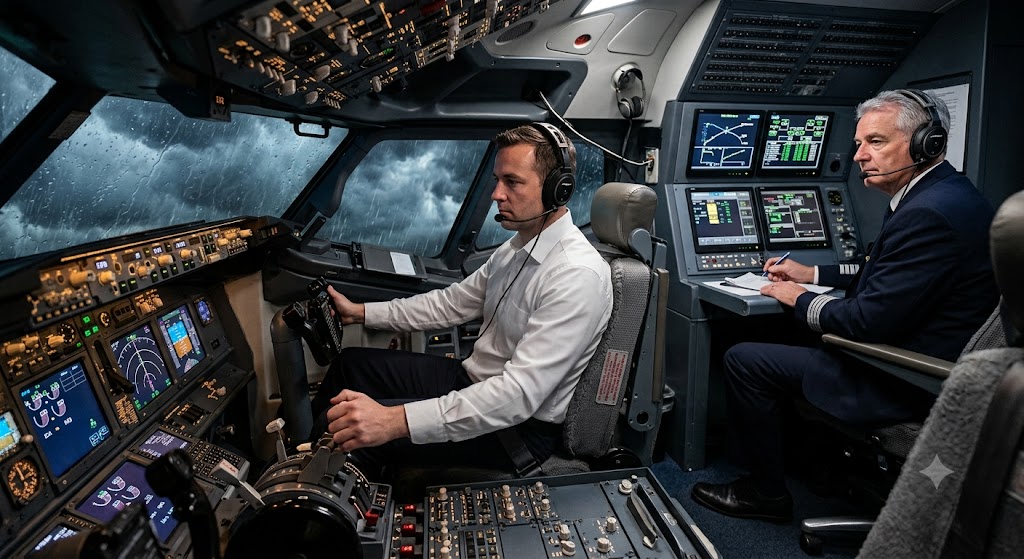
For most pilots this is the stage that generates the sweaty palms, so it is worth being precise about what it is for. The simulator assessment is not a type-rating check, and the airline does not expect you to fly their jet like a line captain. It is an assessment of raw handling, instrument scan, procedural discipline, workload management and — above all — trainability. Assessors will often deliberately coach you mid-session precisely to see whether the next attempt improves. In Australia, both Qantas and Virgin Australia typically run the exercise in a Boeing 737 simulator (Virgin's is conducted at Aviation Australia in Brisbane alongside the COMPASS testing), and the session usually runs sixty to ninety minutes.
The profile is rarely exotic: a briefing, a departure, climbing and descending turns, perhaps steep turns, radar vectors, possibly a hold, and a raw-data ILS to a missed approach. Emergencies are generally absent — this is about basics under observation, not crisis management. You will usually fly with a support pilot in the other seat, and how you use them is itself scored.
Preparation is straightforward and pays off enormously. Get the pitch-and-power numbers for the assessment aircraft — for a 737, knowing roughly what attitude and thrust hold level flight at 210 knots, or a three-degree slope at approach speed, removes half the workload before you ever move the controls. Chair-fly the profile until the sequence and the standard calls are automatic. Brief properly and ask questions in the briefing; nobody ever failed for clarifying the missed approach procedure, and good questions read as good CRM. In the sim, verbalise: say what you're doing and what you intend next, use standard callouts, and delegate — asking the support pilot to handle radios or read a checklist is not weakness, it is exactly the resource use assessors want to see. Many Australian candidates, particularly those coming from single-pilot GA or turboprops onto a jet sim, book a professional simulator preparation session beforehand; providers operate in most capital cities, and one or two hours of familiarisation is cheap insurance against learning the sim's quirks during the assessment itself.
Expect to make mistakes, because everyone does. The assessment is lost not by the blown altitude but by what follows it: fixation, self-flagellation, and a collapsing scan. Acknowledge the error out loud — "correcting back to five thousand" — fix it, and fly on. Recovering gracefully from an error in front of an assessor is worth more than a clean run.
The Australian landscape
A quick tour of home, with the caveat that recruitment details shift constantly and the airline's own careers page always outranks any article, including this one.
Qantas Group. Mainline recruitment runs from online application through SHL testing, a screening interview with pilot leadership and talent acquisition, then an assessment centre combining a group exercise, the 737 simulator assessment and a competency-based panel of senior pilots and HR, followed by exhaustive verification — logbooks, licences, police and security checks — before offer. Allow three to six months. The Group's recruitment feeds more than the red-tailed mainline fleet: QantasLink (with the Q400 fleet and A220s reshaping regional and domestic flying), Jetstar and Network Aviation in the west all draw on group processes, and movement between them has become a defined career pathway. With wide-body renewal, A321XLRs arriving, a wave of long-anticipated retirements and Project Sunrise aircraft now flying, the group's appetite for pilots is the strongest it has been in a generation.
Virgin Australia. The process is deliberately streamlined: online application, a pre-recorded video interview, then an assessment day at Aviation Australia in Brisbane combining the COMPASS aptitude battery with the simulator assessment, and finally behavioural interviews (and, when required, group exercises) at a base. Virgin's 500-hour direct-entry pathway onto the 737 — with specific multi-engine command requirements — remains one of the most accessible jet entry points in the country, and Virgin Australia Regional Airlines recruits E190-E2 first officers for Perth-based regional and resources flying at around the 1,000-hour mark. Expect a strong emphasis on brand fit: Virgin interviews lean noticeably on customer service, resilience and cultural alignment.
Rex. The Saab 340 operation has long been one of Australia's great apprenticeships, and under Air T ownership the airline has been calling for expressions of interest for both first officers and captains as it reactivates the regional network. The process is distinctive: applications sit in a hold file, interviews are convened in batches as recruitment needs arise, and success leads not straight to a start date but to a hold file of up to six months pending a ground school slot — a roughly five-week, famously demanding course with business attire and airline-grade presentation standards from day one. Rex panels probe regional-specific themes: weather decision-making across inland NSW and beyond, flexibility, hand-flying, and sincere commitment to the regional communities the airline exists to serve. The Rex cadet program, run through the Australian Airline Pilot Academy at Wagga Wagga, remains a direct ab-initio pathway to the Saab flight deck.
And the rest. The resources-sector charter operators in the west and north, and the broader GA and freight ecosystem all feed the majors. The classic Australian career arc — instructing or charter, into a regional turboprop, into a jet — remains alive and well, and regional time is interview gold: fast-arriving command, real weather, minimal automation and daily CRM. If your logbook is thin on stories, a few seasons flying the Saab or the Metro will fix that.
How it looks overseas
The fundamentals travel, but the emphasis shifts. Emirates runs online testing, a video interview, then an assessment in Dubai combining group exercises, technical and HR interviews and a 777 or A380 simulator session; direct entry realistically starts around 3,000 hours, and panels probe cultural adaptability, because the job comes with a Dubai address and colleagues from a hundred nations. Cathay Pacific runs sequential assessment days — survive one to be invited to the next — with computer testing, group work, deep technical panels, that famous logbook review, and a full-motion sim. Europe's big low-cost carriers, Ryanair and easyJet among them, use cut-e (Aon) testing and efficient, SOP-centric processes with fixed-base 737 or A320 sim checks; they are buying standardisation and reliability for high-tempo short-haul. The United States is the outlier: hiring at the majors leans heavily on records, referrals and structured panel interviews, with less technical and simulator testing than Australian pilots expect. For any Australian considering the expat route, the preparation playbook in this article still applies — just add research on the specific airline's battery, and go in clear-eyed about contracts, bases and bonding.
On the day
The unglamorous details decide marginal cases. Wear a conservative suit and accept that airline grooming standards apply from the car park onwards. Arrive thirty minutes early. Bring the folder: licence, medical, passport, logbooks, ATPL results, references, spare CVs, a notebook. Phone off — not silent, off.
And understand that the assessment has no off-stage. The receptionist's impression of you finds its way back. The support pilot in the sim is asked for an opinion. The coffee-break chat with a training captain is data. This is not sinister — an airline is simply checking that the composed professional in the panel room and the person in the corridor are the same human. Consistency, across every stage and every interaction, is the quiet meta-competency of the whole process.
If it doesn't go your way
Plenty of pilots now wearing four bars failed their first airline attempt; a knock-back is a data point, not a verdict. Ask for feedback — some airlines provide it, and even a general steer ("technical knowledge below standard for this stage") tells you where to invest. Most carriers allow reapplication after around twelve months. Use the gap deliberately: book the sim prep you skipped, rebuild the technical study routine, add the command or multi-engine hours that thinned your application, and pressure-test your interview stories on a mentor who will be honest with you.
Remember, too, that in Australia a non-answer is often not a no. Hold files and pilot pools are standard practice — Rex's post-interview hold file runs up to six months, and group pools can sit far longer before a course date lands. Keep your licence, medical, IPC and logbook immaculate while you wait, because the call, when it comes, tends to come with short notice.
Final approach
Strip away the psychometrics, the panels and the sim, and the airline interview is asking one question: who are you as a pilot when it counts? The candidates who cross the line are rarely the ones with the fattest logbooks. They are the ones whose records reconcile, whose stories are true and well told, whose knowledge is current, who fly an honest ILS and recover from their own mistakes without drama, and who treat everyone in the building like crew. None of that can be faked in the fortnight before an assessment — but all of it can be built, deliberately, in the months beforehand. Treat preparation like a type rating: structured, scheduled, and taken seriously. The airlines are hiring. Be ready when they call your name.
Further reading
- Qantas — Pilot Careers — current vacancies, requirements and pathways across the Qantas Group.
- Virgin Australia — Pilot Jobs — direct-entry and cadetship information.
- Rex — Careers and the Rex Pilot Cadet Program — Saab 340 positions and the AAPA cadet pathway.
- Flightdeck Consulting — Sydney-founded interview preparation specialists, including their Complete Airline Pilot Interview Work Book.
- Ace the Technical Pilot Interview by Gary V. Bristow — 1,000+ technical Q&As; the standard revision text.
- Handling the Big Jets by D. P. Davies — the classic on jet transport handling, ideal for turboprop-to-jet transitions.
- PilotAptitudeTest.com — guides to COMPASS, PILAPT, cut-e and airline-specific batteries.
- Pilot Assessments (PASS) — airline-specific assessment preparation, including Emirates and Cathay Pacific.
- Rotate — Airline Pilot Interview Guide — a solid general walkthrough of interview stages and questions.
- Boeing Pilot and Technician Outlook — the 20-year global demand forecast behind the hiring wave.
- CASA — Flight Crew Licensing — Australian licensing, medical and English-proficiency requirements.
This article is general information current as at June 2026. Airline recruitment processes, entry requirements, minimum hours and hiring timelines change frequently — always check the airline's own careers page for current details before applying. Not affiliated with Qantas, Virgin Australia, Rex or any airline, assessment provider or service mentioned. Published in June 2026.