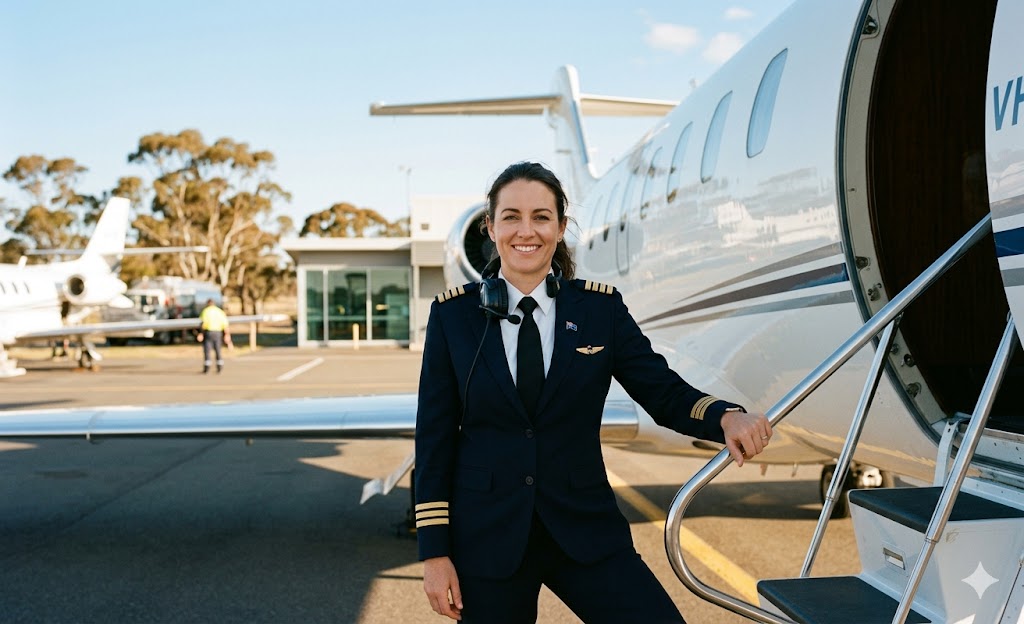
Australia is hiring, and pilots are arriving from everywhere to answer the call. But if you hold an ATPL issued somewhere else — by the FAA, EASA or the UK CAA, Transport Canada, the South African CAA or a Gulf authority — the licence itself doesn't cross the border with you. What does cross is your experience: every hour in your logbook counts here. CASA's job is to convert the paperwork that sits on top of it. The process is thorough, occasionally slow, and full of acronyms, but it's entirely navigable once you understand the sequence. Here's how it works in 2026.
First, pick your pathway
There are two main routes, and choosing the right one saves real time and money.
A full conversion gives you a permanent Australian ATPL. Once issued, it's valid indefinitely, provided you keep your medical and flight review current. This is the path for anyone settling in Australia or joining an Australian operator long-term, and it's what the rest of this article covers.
A Certificate of Validation (CoV) is the short-stay alternative. It lets you fly an Australian-registered aircraft for a specific purpose for up to 12 months — a ferry job, a season of contract work, a type-specific role — without converting anything. If your time in Australia has an end date, a CoV may be all you need.
One special case: New Zealand. Under the Trans-Tasman Mutual Recognition arrangements, NZ CPL and ATPL holders have a far simpler recognition path than everyone else. If your licence is from NZ CAA, look into trans-Tasman recognition before anything below.
Check that your licence qualifies
CASA will only convert a licence issued by an ICAO contracting state, and it must be current, valid and clean — not suspended, cancelled or carrying restrictions imposed by the issuing authority. If your ATPL has lapsed, renew it at home first; converting a dead licence is far harder than converting a live one.
The paperwork — and the bottleneck
The process starts with an Aviation Reference Number (ARN), then an application through the myCASA portal using Form 61-4A — the flight crew licence application on the basis of overseas civil qualifications. You'll need certified copies of your licence, ratings, medical, logbook evidence and identity documents, and anything not in English must come with a certified translation.
Here's the part to plan around: CASA independently verifies your licence with the authority that issued it. You have no control over how quickly a foreign regulator answers, and this step is the single most common cause of delay — weeks if you're lucky, months if you're not. Lodge your 61-4A as early as possible and treat everything else as things to do while you wait.
That waiting time is well spent. You'll need an Australian Class 1 medical, issued through a CASA-designated aviation medical examiner (DAME) — overseas medicals don't carry across. You'll need an ASIC or AVID* security identification, which involves its own background check and processing time. And you'll need evidence of Aviation English Language Proficiency at level 4 or above, either shown on your foreign licence or demonstrated through an assessment.
Once CASA has assessed your application, it writes to you setting out exactly what you must complete.
*Note: While CASA allows you to get your flight crew licence with an AVID, operating as a pilot generally requires accessing major or regional airports. Therefore, most ATPL holders need an ASIC in order to work.
The theory exams
CASA does not recognise foreign exam credits — no matter how many ATPL theory subjects you've passed elsewhere, you sit the Australian conversion exams. The good news is that it's nothing like repeating a full ATPL theory suite.
For an aeroplane ATPL, the conversion exams are AHUF (human factors) and AOSA (the ATPL overseas conversion exam covering Australian air law, rules and procedures), and both must be passed within the same exam window. The AOSA runs three hours with an 80 per cent pass mark, and it's sat with permitted reference materials — you choose either the Airservices or the Jeppesen document set, but you can't mix the two. Helicopter ATPL holders sit AOSH in place of AOSA. If you want instrument privileges and don't hold an Australian instrument theory pass, add the IREX to your list.
One planning note that catches people out: CASA flight crew exams can only be sat within Australia. You cannot knock them over from overseas before you arrive.
The flight test

A professional licence conversion — CPL, MPL or ATPL — always finishes with a flight test conducted by a flight examiner. For the ATPL this is assessed in a multi-crew environment, which in practice usually means an approved full-flight simulator for a multi-crew type, often arranged through an operator or a training provider. Your ratings may carry their own requirements too — converting instrument privileges, for example, typically involves an instrument proficiency check. CASA's assessment letter will spell out precisely which tests apply in your case, because no two conversion files look quite the same.
Pass the exams, pass the test, lodge Form 61-4B to finalise, and the Australian ATPL is yours — permanently.
Be realistic about the timeline
End to end, budget months, not weeks. The efficient sequence is: lodge the 61-4A and get the verification moving first; book the DAME and start the ASIC/AVID immediately; study for AHUF and AOSA while you wait and sit them close together; and line up the simulator and examiner last, once CASA's letter confirms exactly what's required. Pilots who run these steps in parallel convert dramatically faster than those who do them one at a time.
The bottom line
Australia needs experienced pilots, and a foreign ATPL is a genuinely valuable asset here — but CASA converts licences by process, not by reputation. Treat the conversion as a project: verify early, do the paperwork properly, respect the exams (Australian airspace and rules have real local flavour), and book your flight test with an examiner who tests regularly on your category. Your hours got you this far. The conversion is just the last leg of the trip.
Further reading
- CASA — Converting an overseas flight crew licence
- CASA — Overseas licence conversion exams (AHUF, AOSA, AOSH and IREX details)
- CASA — Certificate of Validation on the basis of foreign qualifications (Form 61-4cov)
- Form 61-4A — Flight Crew Licence on basis of overseas civil qualifications (Part 1) — Used for the initial application to convert your foreign civil licence into an Australian licence.
- Form 61-4B — Flight Crew Licence on basis of overseas civil qualifications (Part 2) — Used for the final step in the conversion process to claim your licence after you have met CASA’s requirements.
This article is general information for pilots converting to an Australian licence. CASA requirements, forms and fees change — always confirm the current process directly with CASA before applying. Written by David Roses, June 2026. Not affiliated with CASA.